
Renting an aircraft sounds straightforward until you realize how much can go wrong when you skip the details. An aircraft rental checklist for pilots is not a formality. It is your protection against flying an aircraft with unresolved maintenance issues, discovering mid-trip that your insurance does not cover the deductible, or learning after the fact that your flight review expired at the end of last month, not on the date you thought. This guide covers every critical step: your qualifications, the aircraft's condition, insurance gaps, and the checkout flight. Work through this before you ever sign a rental agreement.
Table of Contents
- Key takeaways
- 1. Confirm your pilot qualifications and regulatory compliance
- 2. Inspect aircraft condition and maintenance transparency
- 3. Understand and secure appropriate renter's insurance
- 4. Conduct the checkout flight with intention
- 5. Know your checklist by pilot profile and flight phase
- My honest take on rental preparation
- Find your next rental aircraft with Nearbyflyer
- FAQ
Key takeaways
| Point | Details |
|---|---|
| Verify your certificates first | Confirm your pilot certificate, medical, and flight review are all current before approaching any FBO. |
| Review maintenance records | Request the logbooks and check annual and 100-hour inspection status before accepting any aircraft. |
| Get your own renter's insurance | FBO insurance covers the aircraft, not you. Personal non-owned aircraft insurance fills the gap. |
| Treat the checkout flight seriously | Use it to learn aircraft quirks, ask about avionics, and clarify every operational policy. |
| Document the aircraft's condition | Photograph any existing damage before departure to protect yourself legally after the flight. |
1. Confirm your pilot qualifications and regulatory compliance
Before you call an FBO or browse rental listings, your own certificates need to be in order. This is the foundation of any aircraft rental guide worth following, and skipping it wastes everyone's time.
Start with your pilot certificate. Confirm it covers the category and class of aircraft you intend to rent. If you want to fly a complex or high-performance aircraft, verify you hold the appropriate endorsement. Many pilots assume their certificate covers more than it does.
Your medical certificate currency matters just as much. Know your medical class, know its expiration, and carry the physical certificate. Some FBOs will ask to see it before the checkout flight.
The flight review requirement catches pilots off guard more often than almost anything else. Flight reviews are required every 24 calendar months, and here is the detail most pilots miss: the review expires at the end of the 24th calendar month, not on the specific anniversary date. If your review was completed on March 15, 2024, it remains valid through March 31, 2026. That distinction can save you from an illegal flight.
FBOs also have their own requirements layered on top of FAA minimums. Pilot certificates, current medicals, and current flight reviews are required for rental pilots, and checkout flights along with proof of non-owned insurance are typically mandated before you get the keys.
- Valid pilot certificate with appropriate category, class, and endorsements
- Current medical certificate (carry the original)
- Flight review completed within the last 24 calendar months
- Any required type-specific endorsements (complex, high-performance, tailwheel)
- Total hours and recent flight time discussed with the FBO prior to rental
- Instrument currency if you plan any IFR operations
Pro Tip: Bring a printed copy of your logbook summary showing recent flight hours. FBOs appreciate pilots who come prepared, and it can speed up the checkout approval process considerably.
2. Inspect aircraft condition and maintenance transparency
A clean cockpit does not mean a safe aircraft. Your job as a renter is to look past the surface and understand the actual maintenance history of what you are about to fly.
Request the maintenance logbooks before you commit to anything. You are looking for the date of the last annual inspection and whether it is still within the 12-month window. Reviewing the last 100-hour and annual inspections and checking for any deferred maintenance is critical for safe rental aircraft operation. Deferred items are not automatically disqualifying, but you need to understand what they are and whether they affect airworthiness.

One important clarification worth knowing: the 100-hour inspection rule applies only when an aircraft is used for hire in instructional or passenger-carrying operations. For pure rental flights where you are the pilot in command and no instruction is taking place, the aircraft can legally fly beyond the 100-hour mark. Knowing this prevents unnecessary confusion when reviewing logs.
Your physical preflight inspection follows the same standards as any flight. FAR 91.103 requires pilots to verify airworthiness documents, fuel quantity, weight and balance, and weather conditions before every flight. For rental aircraft, add one more layer: photograph any existing damage, scratches, or dents before you depart. Documenting pre-existing damage creates a baseline that protects you legally if there is any dispute after the flight.
| Inspection item | What to check | Red flag |
|---|---|---|
| Annual inspection | Date in airframe logbook | Expired or approaching expiration |
| Engine logbook | Time since overhaul (SMOH/TSMOH) | Approaching TBO with no plan |
| Squawk sheet | Open maintenance items | Unresolved avionics or systems issues |
| Physical condition | Tires, oil level, control surfaces | Visible wear, leaks, or damage |
| AROW documents | Airworthiness, Registration, Operating handbook, Weight and balance | Any document missing or expired |
Pro Tip: Ask the FBO how they handle squawk reporting. A rental provider with a clear, easy squawk process signals a safety-conscious operation. One that discourages reporting is a warning sign.
You can find aviation maintenance providers through Verde Aviation on Nearbyflyer if you want a reference point for what a reputable maintenance operation looks like.
3. Understand and secure appropriate renter's insurance
This is where most pilots have a dangerous blind spot. FBO insurance covers the aircraft. It does not cover you.
When an FBO carries hull insurance on their aircraft, that policy protects the FBO's asset. If you damage the aircraft, the FBO's insurer may pay for repairs and then pursue you through subrogation to recover those costs. Hull deductibles can reach $2,500 to $10,000, and personal liability gaps require individual coverage to close. Without your own policy, you are personally exposed to that entire amount.
FBO insurance requirements typically demand that renters provide certificates listing the FBO as an additional insured, with liability coverage limits varying by aircraft complexity. For simple trainers, limits often start around $500,000. For complex aircraft, typical liability limits range from $500,000 to $2,000,000 per occurrence.
Personal non-owned aircraft insurance is the product that fills this gap. It travels with you to any aircraft you rent and covers your liability as pilot in command. One critical detail: non-owned aircraft insurance policies typically exclude coverage of deductibles unless you specifically purchase that add-on. Read your policy carefully before assuming you are fully protected.
"Proper renters insurance is both a financial safeguard and a compliance enabler, unlocking access to more aircraft at more facilities." — Insight from FBO insurance research
- Confirm the FBO's minimum liability coverage requirement before signing
- Obtain your own non-owned aircraft insurance policy
- Request a certificate of insurance naming the FBO as additional insured
- Verify your policy includes deductible coverage (it often does not by default)
- Understand whether your policy covers passengers and what limits apply
- Keep a digital copy of your insurance certificate accessible on your phone
4. Conduct the checkout flight with intention
Most pilots treat the checkout flight as a test to pass. That framing is wrong. The checkout flight is a vital opportunity to learn aircraft-specific quirks, avionics details, and operational policies rather than just a formality.
Here is how to approach it productively:
- Ask about known quirks before you fly. Every aircraft has them. One Cessna 172 might have a sticky carb heat. Another might have an altimeter that reads slightly off. Ask the CFI or FBO staff what they would want to know before flying that specific aircraft.
- Work through the avionics deliberately. If the aircraft has a glass panel, a GPS navigator, or an autopilot you are not fully familiar with, use the ground portion of the checkout to get comfortable. Fumbling with avionics in the air is a distraction you do not need.
- Clarify every operational policy. FBO policies vary on fuel return requirements, geographic restrictions, and cancellation and refund policies. Ask specifically: Do you return the aircraft full? Are there restricted airspace areas or geographic boundaries? What is the cancellation window?
- Evaluate the FBO's safety culture. How the checkout instructor responds to your questions tells you a lot. A CFI who encourages questions and volunteers information is a good sign. One who rushes through the process is not.
- Confirm emergency procedures for that specific aircraft. Knowing the general emergency checklist is not enough. Ask where the fire extinguisher is, how the doors open from the outside, and whether there are any known emergency procedure deviations from the POH.
Pro Tip: Bring a notepad or use your phone to take notes during the ground portion of the checkout. You will not remember every detail in the air, and reviewing your notes before subsequent flights reinforces the aircraft-specific knowledge.
If you need a qualified CFI for a checkout flight, Fly Time Aviation on Nearbyflyer is one example of the kind of instructor resource the platform connects pilots with.
5. Know your checklist by pilot profile and flight phase
Not every pilot needs to weight every checklist item equally. Here is a practical breakdown based on who you are and when you are flying.
Student pilots and low-hour renters should prioritize the checkout flight and insurance steps above everything else. Your unfamiliarity with the aircraft is the biggest risk factor, and your personal liability exposure is real from the first flight.
Experienced pilots transitioning to complex aircraft need to focus hardest on endorsement verification, aircraft-specific emergency procedures, and insurance limits. The liability coverage requirements scale up significantly for complex aircraft, and your existing non-owned policy may not cover the higher deductible.
Occasional renters who fly fewer than 10 hours per month should pay close attention to flight review currency and recent flight experience. An FBO may require a refresher flight if you have not rented in several months, even if your certificates are technically current.
| Phase | Priority checklist items |
|---|---|
| Before rental agreement | Certificates, medical, flight review, insurance certificate |
| Before first flight | Maintenance logs, AROW documents, physical inspection, photos of existing damage |
| During checkout | Aircraft quirks, avionics, emergency procedures, FBO operational policies |
| After each flight | Squawk reporting, fuel return compliance, accurate Hobbs/tach time recording |
Common pitfalls to avoid:
- Assuming your flight review date is exact rather than end-of-month
- Signing a rental agreement without reading the geographic restriction clause
- Flying without confirming your non-owned insurance certificate is on file with the FBO
- Skipping the physical inspection because the aircraft "looks fine"
My honest take on rental preparation
I have seen pilots with hundreds of hours in their logbooks show up to rent an aircraft and treat the checkout like an inconvenience. That attitude worries me more than a low-hour student who asks a lot of questions.
In my experience, the pilots who get into trouble with rentals are not the ones who lack skill. They are the ones who assume the FBO has handled everything. The FBO has handled the aircraft's airworthiness. They have not handled your insurance gap, your flight review currency, or your familiarity with that specific airframe.
What I have learned from watching pilots navigate this process is that the checklist is not bureaucracy. It is the difference between a flight where you are genuinely in command and one where you are hoping nothing goes wrong. The relationship you build with your rental provider through honest communication and consistent professionalism also pays dividends over time. You get better scheduling, early notice on aircraft availability, and a staff that actually wants to help you succeed.
My advice: reframe every item on this checklist as something you are doing for yourself, not for the FBO. Your certificate, your finances, and your safety are all on the line every time you climb in.
— Bryce
Find your next rental aircraft with Nearbyflyer
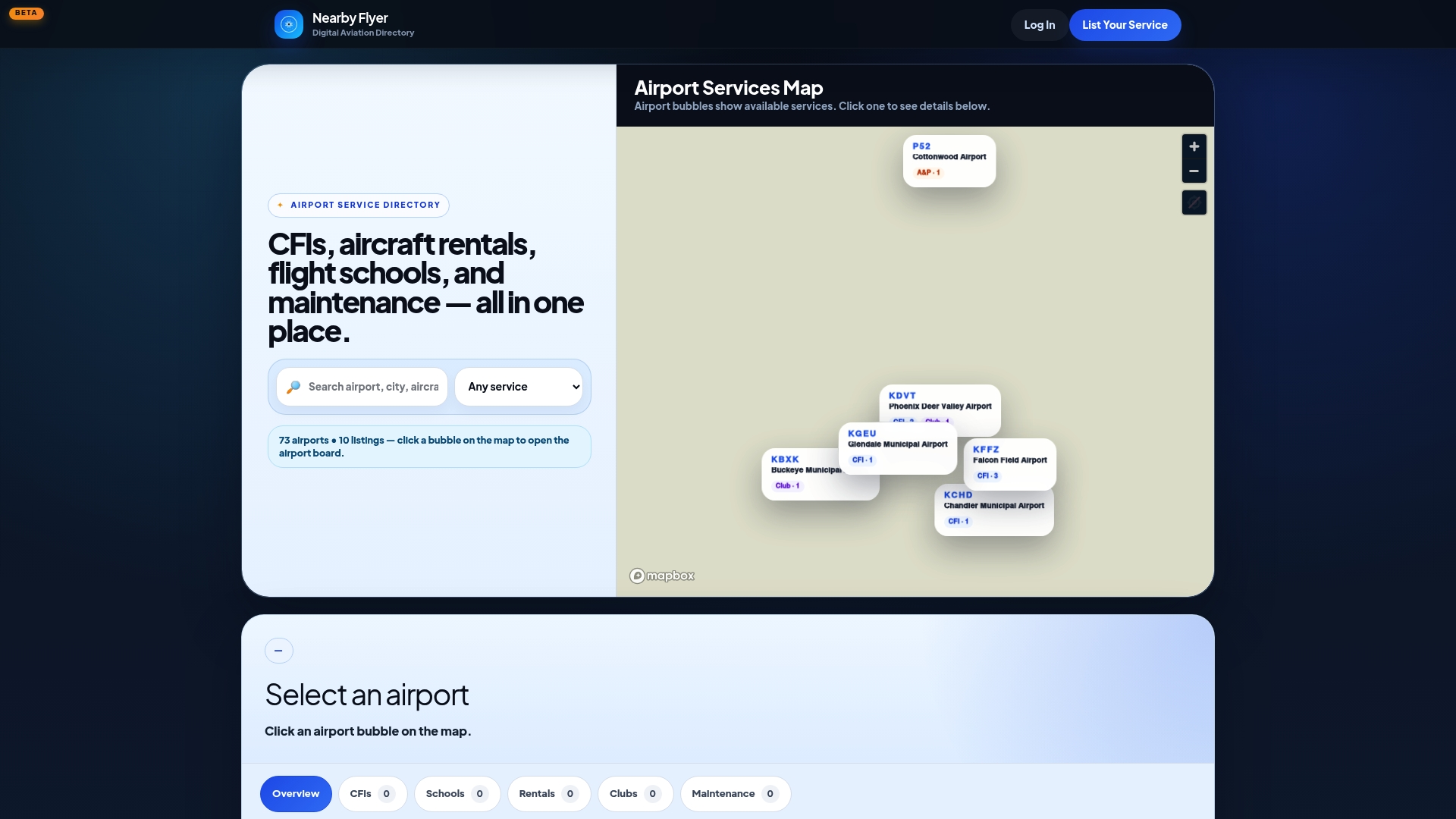
Planning a rental flight starts with finding the right aircraft at the right airport, and that search does not need to be scattered across a dozen websites. Nearbyflyer consolidates aircraft rentals, CFIs, flight schools, and maintenance services across 73 airports into one interactive map. Click on any airport to see what is available locally, from checkout flight instructors to rental aircraft listings.
Whether you are planning a cross-country trip out of Valle Airport near the Grand Canyon or looking for a local trainer at Avi Suquilla Airport in Parker, AZ, Nearbyflyer gives you a direct view of available services without the guesswork. Explore the full airport services map and find a rental provider that meets every item on your checklist.
FAQ
What documents do I need to rent an aircraft?
You need a valid pilot certificate with appropriate ratings, a current medical certificate, and a flight review completed within the last 24 calendar months. Most FBOs also require proof of personal non-owned aircraft insurance before releasing the aircraft.
Does FBO insurance cover me as the renter pilot?
No. FBO insurance covers the aircraft itself, not the pilot. You need your own non-owned aircraft renter's insurance to cover personal liability and potentially the hull deductible, which can reach up to $10,000 depending on the aircraft.
How often do I need a flight review to rent legally?
A flight review is required every 24 calendar months. It expires at the end of the 24th calendar month, not on the specific date it was completed, so your valid window may extend slightly longer than you expect.
What should I check during the aircraft preflight inspection?
Verify all AROW documents are present and current, check fuel quantity and oil level, inspect tires and control surfaces for wear or damage, and photograph any pre-existing damage. FAR 91.103 requires this inspection before every flight.
Can I fly a rental aircraft past the 100-hour inspection mark?
Yes, in most rental situations. The 100-hour inspection rule applies only when an aircraft is used for hire in instructional or passenger-carrying operations. For solo rental flights where no instruction is taking place, the aircraft can legally be flown beyond the 100-hour mark as long as the annual inspection is current.