
Most people assume aviation training is a simple checklist: get your private license, add ratings, apply to an airline. That misunderstanding costs aspiring pilots time, money, and career momentum. Understanding how aviation career programs are structured means recognizing that sequencing, program type, and formal airline backing all shape your outcomes in ways that a basic flight hour count never will. This article breaks down the phases, the distinctions between program types, and the financial realities you need to know before you commit.
Table of Contents
- Key takeaways
- How aviation career programs are structured: the core phases
- Career tracks vs. airline pathways: what the difference actually costs you
- Types of aviation training programs beyond the cockpit
- Financial and logistical realities of aviation programs
- My honest take on what actually matters in program selection
- Find your training resources with Nearbyflyer
- FAQ
Key takeaways
| Point | Details |
|---|---|
| Sequencing matters more than speed | Building certifications in the correct order reduces total flight hours and improves skill retention. |
| Career Tracks beat general pathways | Formal airline-backed programs offer mentorship and guaranteed interviews that informal pathways cannot match. |
| Aviation careers go beyond flying | Maintenance, air traffic control, and degree-integrated programs each follow their own structured paths. |
| Part 141 accelerates progress | Standardized lessons and stage checks in Part 141 programs reduce redundant training compared to Part 61. |
| Costs vary widely by program type | Fixed-wing commercial training runs $59,000 to $79,000, so choosing the right structure directly affects your budget. |
How aviation career programs are structured: the core phases
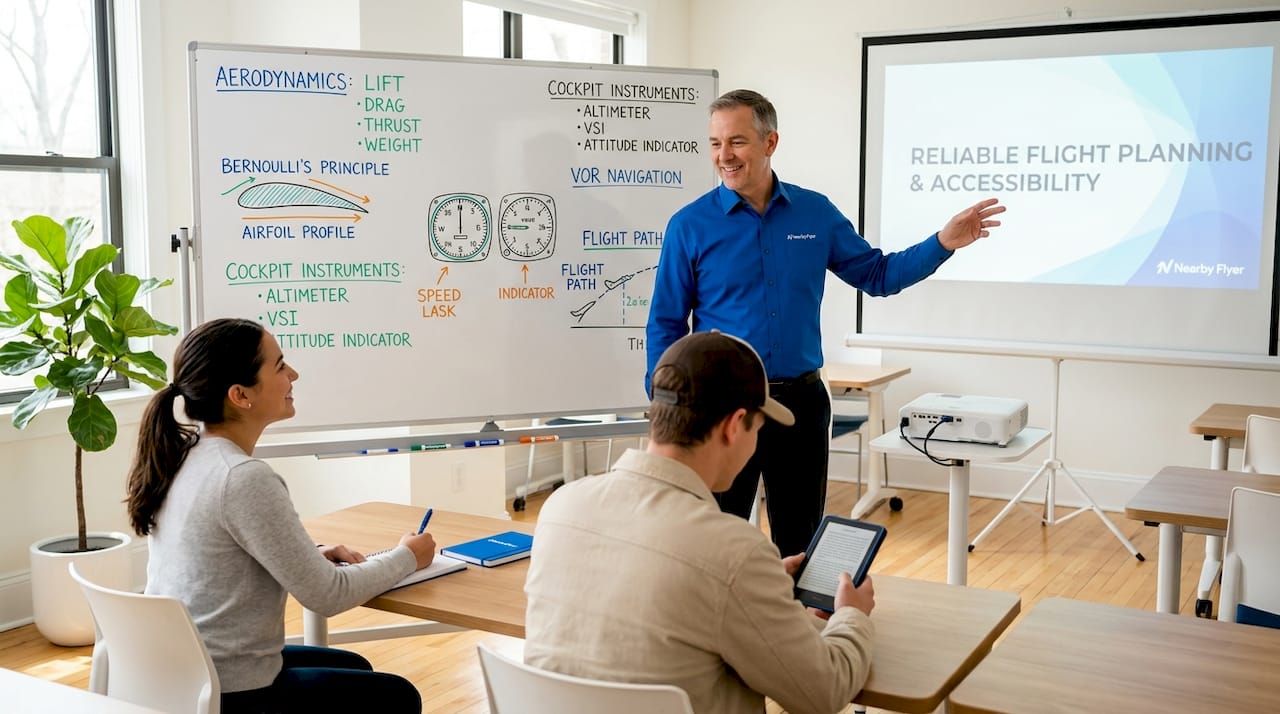
The standard aviation program curriculum does not start at the airline cockpit. It builds toward it through a deliberate sequence of certifications, each one expanding on the last. Getting this order right is not optional. It is the difference between a smooth progression and expensive backtracking.
Here is the typical sequence for a professional pilot program:
- Private Pilot Certificate (PPL): Your foundation. You learn basic flight maneuvers, navigation, and weather interpretation. This is where you develop the instincts everything else depends on.
- Instrument Rating (IR): You learn to fly by reference to instruments alone. This rating is what separates recreational flying from professional-grade operations in real weather.
- Commercial Pilot Certificate (CPL): You are now legally permitted to be paid to fly. The maneuver standards tighten considerably here.
- Multi-Engine Rating: Adds the skills needed to operate aircraft with more than one engine, which is required for most airline and charter positions.
- Certified Flight Instructor (CFI): Many pilots pursue this immediately after their commercial certificate. Teaching others is one of the fastest ways to build the 1,500 flight hours required for an Airline Transport Pilot certificate.
- Airline Transport Pilot (ATP): The top-level certificate required to serve as pilot-in-command at an airline.
What most candidates miss is the value of combining phases rather than treating each one as a separate event. Combining commercial and CFI training produces deeper mastery, reduces total flight hours, and sharpens decision-making in ways that sequential, isolated training does not. You are not just logging hours. You are learning to explain and defend every maneuver, which forces a level of precision that solo practice rarely demands.
Pro Tip: If your program allows it, begin your CFI preparation while finishing your commercial certificate. The overlap builds stronger habits and cuts down on the total time to your ATP minimums.
The structure of the program itself also matters. Part 141 schools operate under FAA-approved course outlines with scheduled flight blocks and stage checks at defined milestones. Part 141 programs reduce redundant training and accelerate progression in ways that the more flexible Part 61 approach cannot guarantee. Part 61 works well for self-directed learners with irregular schedules, but if career speed is your priority, Part 141 is the better structure.
Career tracks vs. airline pathways: what the difference actually costs you
This is where the marketing gets confusing. Many flight schools advertise "airline pathways" that sound like formal partnerships but carry no actual contractual weight. Understanding the difference is one of the most important steps to enter the aviation field with your eyes open.
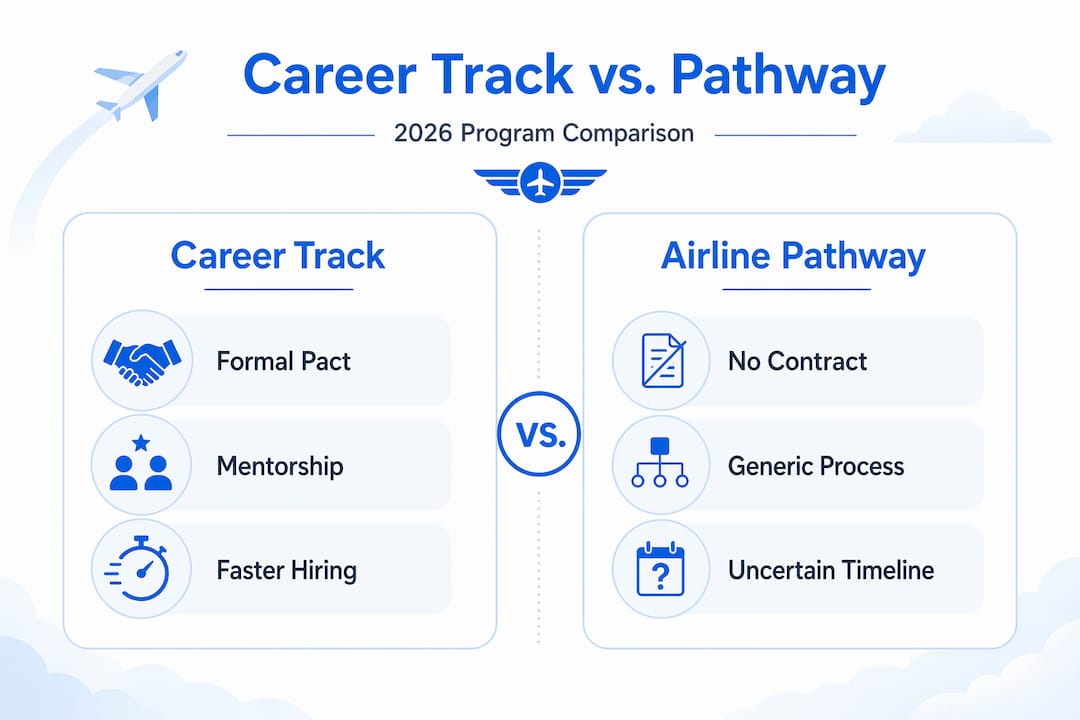
Career Tracks™ are formal airline-backed programs that include structured recruitment timelines, mentorship from active airline pilots, and guaranteed interviews upon meeting defined milestones. A general "pathway" is typically a marketing label. It may describe a school's historical relationship with an airline, but it offers no binding agreement, no mentorship structure, and no guaranteed access to the hiring pipeline.
Here is how the two compare side by side:
| Feature | Career Tracks™ | General airline pathways |
|---|---|---|
| Formal airline agreement | Yes | No |
| Structured mentorship | Yes | Rarely |
| Guaranteed interview | Yes, upon meeting milestones | No |
| Defined career milestones | Yes | Vague or absent |
| Hiring pipeline access | Direct | Competitive, open market |
| Program accountability | High | Varies widely |
The gap matters more than most candidates realize. Airline-backed programs with structured mentorship offer measurable advantages in job placement and career preparation. When two candidates with identical flight hours apply to the same regional airline, the one with a formal Career Track relationship and a mentorship record has a structural advantage that flight hours alone cannot replicate.
Pro Tip: When evaluating any program that claims an airline relationship, ask for the written agreement. If the school cannot produce a formal document, the "pathway" is a marketing description, not a career guarantee.
You should also evaluate programs based on FAA certification alignment and whether the training standards match the operational expectations of your target airline. Some regional carriers prefer candidates from specific Part 141 schools because the standardization makes onboarding faster.
Types of aviation training programs beyond the cockpit
Pilot training gets most of the attention, but the aviation industry runs on multiple specialized workforces. The structure of aviation education looks quite different depending on which career path you choose.
Here is a breakdown of the major program types:
-
Aviation maintenance technician (AMT) programs: These programs typically run 18 to 24 months and lead to FAA Airframe and Powerplant (A&P) certification. The curriculum covers airframe structures, engine systems, hydraulics, and avionics. Many community colleges and vocational schools offer accredited AMT programs. For a practical look at how maintenance services fit into local aviation ecosystems, Verde Aviation's maintenance listing on Nearbyflyer shows what professional maintenance operations look like at the airport level.
-
Air traffic controller (ATC) programs: These are among the most structured programs in aviation. The path includes an FAA-approved collegiate program, followed by the FAA Academy in Oklahoma City, and then on-the-job training at an assigned facility. Controller training takes 2 to 4 years to complete. The FAA is actively expanding this workforce, with 11,000 certified controllers and 4,000 in training as of mid-2026, aiming for a total of 12,563 controllers.
-
Degree-integrated pilot programs: These combine a four-year aviation degree with flight training. The FAA does not require a college degree for pilots, but degree-integrated programs enhance career prospects and provide a fallback if a medical issue interrupts a flying career. Many major airlines give preference to degree holders during hiring.
-
Helicopter pilot programs: The aviation training program details for rotor-wing pilots follow a similar certification sequence as fixed-wing, but the aircraft systems and flight dynamics require separate ratings. The curriculum is structured around the same FAA certification framework.
Each of these paths has its own timeline, cost structure, and regulatory requirements. Choosing the right one starts with knowing where you want to land, literally and professionally.
Financial and logistical realities of aviation programs
Cost is where many aspiring aviators get surprised. The aviation career program benefits of a structured school come with a real price tag, and understanding what drives that cost helps you choose more wisely.
| Program type | Typical cost range | Average duration |
|---|---|---|
| Fixed-wing commercial pilot | $59,000 to $79,000 | 12 to 24 months |
| Helicopter commercial pilot | $45,000 to $75,000 | 12 to 24 months |
| Aviation maintenance (A&P) | $15,000 to $35,000 | 18 to 24 months |
| ATC collegiate program | $20,000 to $50,000 | 2 to 4 years |
Commercial pilot training costs range from $59,000 to $79,000 for fixed-wing and $45,000 to $75,000 for helicopters, with variation driven by training frequency and individual proficiency. Students who train more consistently progress faster and spend less in the long run because aircraft rental and instructor fees accumulate with every delay.
Instructor quality is a factor that rarely appears in brochures but significantly affects your total cost. A standardized Part 141 program with experienced instructors who follow a consistent syllabus will produce fewer repeated lessons than a Part 61 environment where instruction quality varies by individual. The correct sequencing and integration of training phases reduces unnecessary hours and keeps your total spend closer to the low end of any cost estimate.
Full-time, self-pay enrollment also matters more than most candidates expect. Students who commit to full-time schedules maintain currency in the aircraft, retain information between lessons, and finish programs months ahead of part-time peers. That time difference translates directly into earlier entry into the job market and earlier salary accumulation.
Pro Tip: Before enrolling, ask the school for its average time-to-completion data for full-time students. If they cannot provide it, that is a meaningful signal about how seriously they track student outcomes.
My honest take on what actually matters in program selection
I have spent enough time around flight training to say this directly: most candidates spend too much time comparing aircraft fleets and not enough time asking about instructor retention and stage-check pass rates.
The sequencing of your certifications is not just an administrative detail. It is the architecture of your competence. I have seen pilots rush through their instrument rating to get to commercial hours faster, only to struggle with IFR procedures during airline training because the foundation was thin. Getting each phase right before moving forward is not slow. It is efficient.
The Career Track versus pathway distinction is where I see the most expensive mistakes. Schools with genuine airline partnerships are not shy about showing you the paperwork. If a school talks about its airline relationships in general terms without specifics, you are looking at a marketing claim, not a career structure.
My advice: look for programs where the instructor staff includes working airline pilots or recent airline hires. That cross-pollination of current industry standards into the training environment is worth more than any fleet size or campus amenity. The flight instructor resources available at local airports are often overlooked by candidates fixated on large national schools, but independent CFIs with airline backgrounds can offer focused, high-quality instruction at a fraction of the cost.
Aviation programs are not all created equal, and neither are the careers they produce. Choose the structure that matches where you actually want to go.
— Bryce
Find your training resources with Nearbyflyer
If you are serious about starting your aviation career, the next step is getting familiar with the airports and services near you.
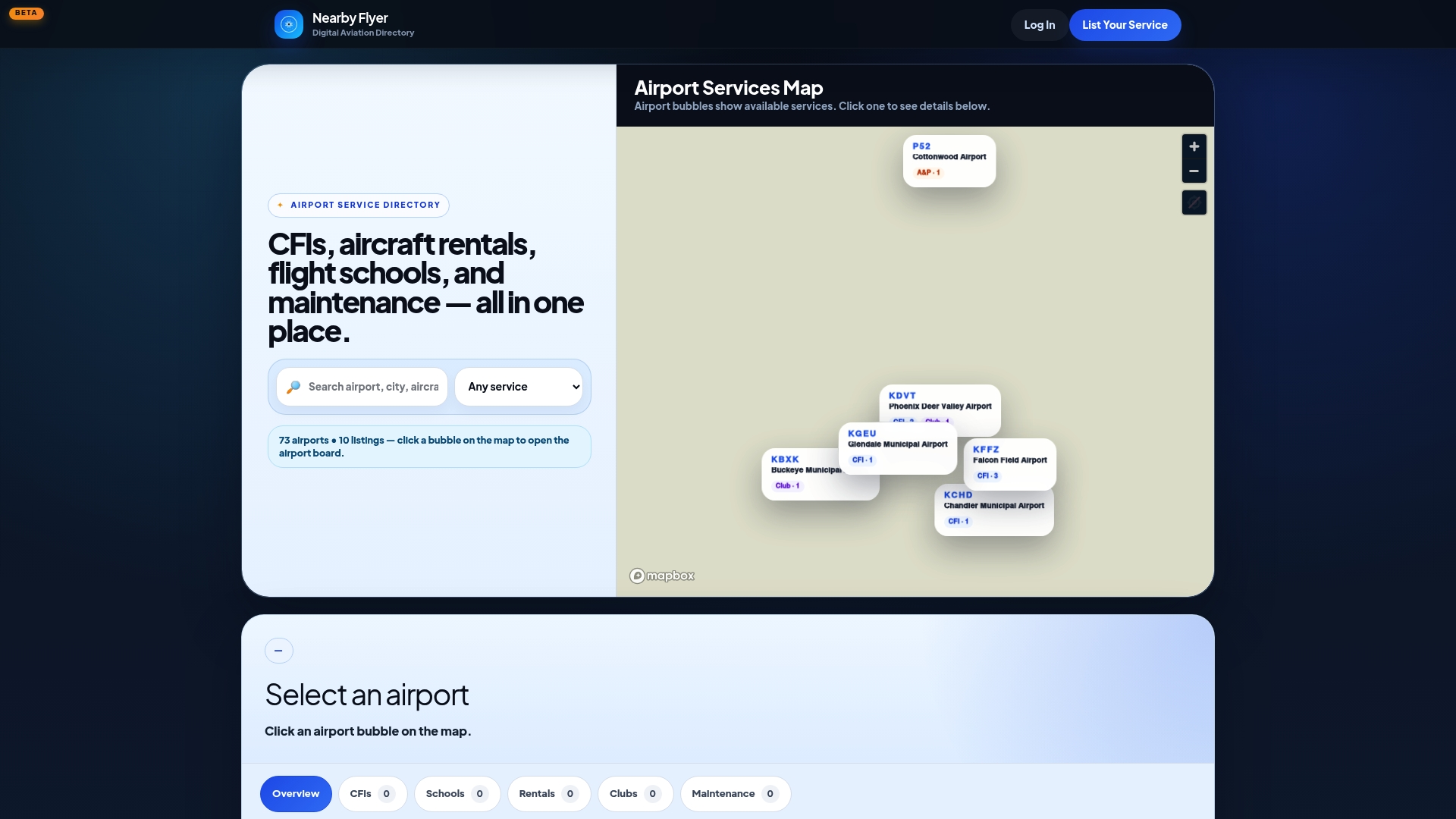
Nearbyflyer's interactive airport services map lets you explore flight schools, CFIs, aircraft rentals, and maintenance providers at airports across 73 locations. Instead of searching through disconnected listings, you can click directly on an airport and see exactly what training resources are available there. Whether you are looking for a local flight instructor to start your PPL or scoping out maintenance programs near you, airports like Taylor Airport (KTYL) and Avi Suquilla Airport (KP20) are listed with their full service profiles. Use Nearbyflyer to match your training goals with real, nearby resources before you commit to a program.
FAQ
What are the main phases of a pilot career program?
The standard sequence runs from Private Pilot Certificate through Instrument Rating, Commercial Pilot Certificate, Multi-Engine Rating, CFI, and finally the Airline Transport Pilot certificate, which requires a minimum of 1,500 flight hours.
What is the difference between Part 141 and Part 61 training?
Part 141 programs follow FAA-approved syllabi with scheduled lessons and stage checks, which reduces redundant training and speeds up progression. Part 61 is more flexible but less structured, making it better suited for self-directed learners with irregular schedules.
How much does commercial pilot training cost?
Fixed-wing commercial pilot programs typically cost between $59,000 and $79,000, while helicopter programs range from $45,000 to $75,000, depending on training frequency and individual proficiency.
What is a Career Track and why does it matter?
A Career Track is a formal, contractual agreement between a flight school and an airline that includes structured mentorship, defined milestones, and a guaranteed interview. Unlike general airline pathways, Career Tracks provide binding career support rather than informal marketing relationships.
Do I need a college degree to become an airline pilot?
The FAA does not require a college degree for pilot certification, but degree-integrated aviation programs improve hiring prospects with major airlines and provide career alternatives if a medical issue prevents flying.